About This Book
Who this book is for
This book is written for DevOps engineers, site reliability engineers, and platform teams who operate production workloads on AWS. If you are responsible for incident response, observability, or operational automation, you will find practical guidance for adding AWS DevOps Agent to your environment. The material assumes you already manage AWS infrastructure and need concrete patterns for autonomous investigation and remediation.
What you will learn and build
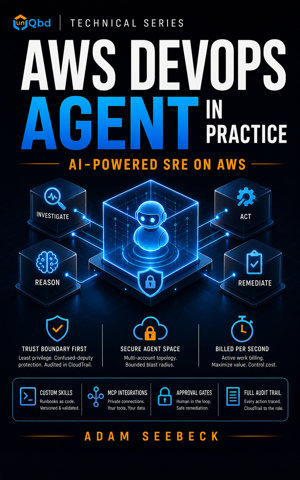
You will learn how to deploy, configure, and run AWS DevOps Agent for production incident response and SRE tasks. The book covers Agent Space design, least-privilege IAM roles, and integration architecture for tools such as CloudWatch, PagerDuty, Splunk, and Datadog. You will author Custom Skills using SKILL.md, build private MCP servers in Python, and configure approval-gated remediation workflows. Later chapters address multi-cloud investigations, cross-platform handoffs, evaluation suites for accuracy benchmarks, and governance models that treat Skill changes like production code. By the end, you will have implemented a complete operational workflow from alarm to post-incident review, including a Learned Skill and a prevention agent.
How to use this book (recommended reading path)
Read Part I to understand the service topology, ownership model, and the differences between AWS DevOps Agent, Bedrock AgentCore, and Amazon Q Developer. Part II walks through creating a secure Agent Space, connecting integrations, and building Custom Skills and MCP servers; work through these chapters in order because each layer depends on the previous one. Part III covers live incident investigation, on-demand SRE work, and prevention workflows. Part IV brings everything together with testing, governance, and a full case study based on verified customer patterns. If you are already familiar with Agent Spaces, you may move quickly to Part II, but do not skip the security and permission boundaries in Chapter 4.
High-level prerequisites
You need an AWS account with administrative or sufficient IAM privileges, access to supported regions, and familiarity with core AWS services. Chapters involving MCP servers require Python, VS Code, and the Python extension. Experience with boto3, virtual environments, and Git is helpful. No background in machine learning or large language models is required; the book focuses on operational configuration rather than model training.
