About This Book
Who this book is for
This book speaks to developers who already write C# and now want to know what the compiler and runtime actually do. If you have one to three years of professional or hobby experience, or you have completed a solid fundamentals course, you have enough context to follow the reasoning. The text is written for reading or listening away from a screen, so you can absorb the mental models while commuting, exercising, or resting. No second monitor is required; the explanations live in the prose.
What you will learn and build
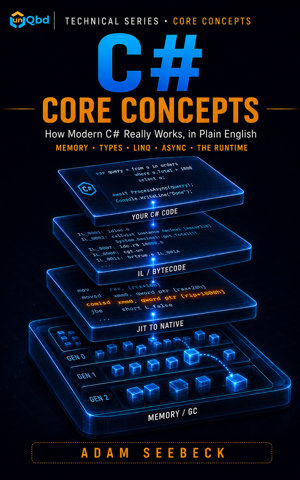
You will build accurate mental models of how C# 14 on .NET 10 executes your programs. Instead of memorizing syntax, you will learn to trace a promise from the language specification through Roslyn compilation to Intermediate Language, then through the Common Language Runtime to native code. You will learn how value and reference semantics differ, how the generational garbage collector manages object lifetime, how generics avoid boxing while preserving type safety, how closures carry captured variables, how LINQ defers execution through expression trees, how async and await use state machines and continuations, and how nullability, collections, and spans interact with memory safety and performance. The book uses analogies and narrated walkthroughs rather than exhaustive API listings. You will not build a sample application; you will build judgment.
How to use this book (recommended reading path)
Read the four parts in sequence. Part I establishes the habit of runtime thinking. Part II anchors memory and meaning with values, references, and garbage collection. Part III puts abstractions in motion with generics, delegates, LINQ, and async. Part IV applies that foundation to failure design, nullability patterns, and performance instincts. Later chapters assume you have absorbed the earlier mental models, so skipping ahead may leave gaps. Each chapter closes with a concise recap you can use to test your recall before moving on.
High-level prerequisites
You should already know how to write methods, classes, conditionals, and loops in C#. You do not need a computer science degree, advanced mathematics, or prior knowledge of compilers. The book explains Intermediate Language, just-in-time compilation, and garbage collection from the ground up using plain language and concrete analogies. Familiarity with Visual Studio or the .NET command line is helpful but not required.
