Chapter 1: Thinking Like the Runtime
What You Will Learn
- Understand the three-layer reasoning habit of tracing behavior from language promise through compiler output to runtime execution
- Recognize the four roles in the modern .NET 10 toolchain and how handoffs work between them
- Distinguish between what the C# language guarantees, what Roslyn emits, and what the Common Language Runtime does
- Explain why this book treats C# 14 as a clarifying lens rather than a feature catalog
- Trace unexpected behavior back through source intent, Intermediate Language, and execution
Prerequisites
No additional prerequisites beyond those listed in About This Book.
Why This Matters
Developers who write C# every day often treat the language as a black box. When a program surprises them, they guess. They blame the compiler, or they blame the runtime, or they rewrite perfectly good source code without knowing which layer actually failed them. This habit wastes hours and teaches nothing.
You already know how to write C#. What you need now is the ability to predict what will happen before you run the program, and to diagnose what did happen when your prediction fails. It's not enough to trust the black box; you need to know which layer actually failed you.
This chapter gives you that map. Everything that follows, from memory management to asynchronous execution, depends on this three-layer habit.
Core Analogy
Imagine an architect sketching a welcoming front porch with exact dimensions. A drafter then redraws that sketch into a universal construction specification that does not depend on any local building code. That specification travels to a job site far away, where a construction crew reads it and builds the porch using local lumber and tools. When the finished porch sags, the foreman checks the original sketch, the translated spec, and the on-site workmanship before deciding where the fault lies.
In this analogy, the architect's sketch is your C# source code stating clear intent. The drafter is the Roslyn compiler, translating that intent into Intermediate Language stored inside an assembly. The universal specification is the assembly itself, which travels to any compatible machine that carries the .NET 10 runtime and its dependencies. The drafting office and tool shed that equip both the drafter and the crew map to the free and open-source .NET 10 Software Development Kit; it provides the tools, yet it remains distinct from the hands that build. The construction crew is the Common Language Runtime, reading that specification and adapting it to the actual processor. The sagging porch is any unexpected behavior; the foreman's inspection is your disciplined trace back through language promise, compiler output, and runtime execution.
Mental Model
The modern .NET toolchain contains four distinct roles. The free and open-source .NET 10 Software Development Kit (SDK) provides the toolset. Roslyn, the C# compiler, transforms your source into Intermediate Language. The assembly is the portable container that carries that Intermediate Language. The Common Language Runtime is the execution engine that brings it to life on a specific chip.
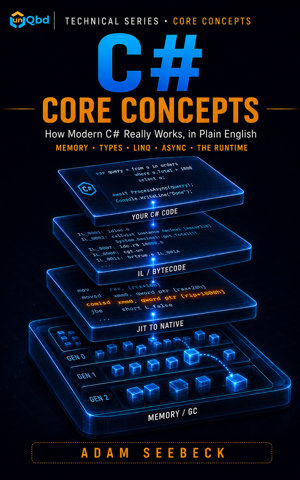
Your job as a developer is to reason across three layers mapped to those four roles. The top layer is the language promise living in your source code. C# 14, which reached general availability in November 2025, defines those guarantees. The middle layer is compiler behavior; Roslyn decides how to express your intent in Intermediate Language. The bottom layer is runtime behavior. The Common Language Runtime translates Intermediate Language into native machine code, meaning the actual instructions understood by the specific processor in front of you; that translation step is just-in-time compilation itself, and through tiered compilation the runtime keeps re-optimizing hot paths as the program runs. Alongside that, it provides managed execution, memory management, and thread pool services.
When you read C# source, you are reading the architect's vision. When you build, Roslyn produces the specification. When you run, the Common Language Runtime builds the porch. A mismatch can appear at any handoff, though in daily practice the source layer is where most errors begin. The language spec might be misunderstood. The Just-In-Time compiler, which is part of the runtime, might optimize away a branch you expected to remain when it turns Intermediate Language into native code. The runtime might reorder instructions within the limits of the .NET memory model and observable behavior rules; those constraints protect single-threaded logic, but the result can still surprise you if you expected a literal step-by-step match to the source.
Treat the source code as a question, not an answer.
This book uses C# 14 as a clarifying lens, not a feature catalog. Where a new C# 14 capability helps explain what the compiler or runtime is doing, we will mention it. We will not tour every new keyword for its own sake. The runtime mechanics have stayed stable across versions; most new syntax compiles down to patterns the runtime already understood before that syntax existed.
New syntax is not new machinery.
During a migration last year, I traced a phantom bug to a stale assembly in the deployment folder; the team had nearly rewritten the caching layer before we checked the handoff between build and runtime. That is why you trace before you blame.
.NET 10 is a Long-Term Support (LTS) release, supported through November 2028. The concepts here are evergreen, but we will note version callouts when a capability changed recently.
Walkthrough
You sketch a welcoming front porch. You want a deck ten feet wide, six feet deep, with a roof pitched at thirty degrees. This is your source code; it states intent in terms humans understand.
You hand the sketch to a drafter. She does not build anything. Instead, she redraws your vision into a universal specification that uses no brand names and assumes no local lumber yard. Every joint, angle, and beam is described precisely, but in a language any qualified crew can read. This is Roslyn compiling your C# into Intermediate Language and sealing it inside an assembly. The assembly is just a file, but it is a file that can travel to any supported operating system where the .NET 10 runtime and compatible dependencies are present.
That specification arrives at a job site two thousand miles away. The local crew cannot read your original sketch. They read the universal spec. They choose local pine because that is what grows nearby. They use their own saws and their own nails. The finished porch looks exactly like your sketch, but it is built from local materials. This is the Common Language Runtime executing your Intermediate Language on an actual processor. The chip might be from Intel, AMD, or Arm; the runtime adapts the spec to whatever is available.
Six months later, the porch sags three inches on the left. The homeowner calls you. You do not immediately blame the pine, nor do you blame the architect's pencil. You inspect the original sketch first. It specified a support post every four feet. You inspect the drafter's universal spec next. It preserved that spacing.
Finally, you inspect the workmanship and the local conditions. The crew built exactly what the spec described; the spec preserved exactly what the sketch described; and the sketch itself called for nails where the load needed bolts, so every layer faithfully delivered the wrong fastener. The soil was also wetter than the standard assumed. The fastener fault traces all the way back to the source; the wet soil is the runtime layer, where the execution environment diverged from the plan.
Now reverse the scenario. You inspect the drafter's universal spec and discover that your thirty-degree roof pitch was translated into a different angle. The crew built faithfully from that spec. The fault lies at the compiler layer, where Roslyn translated your intent into Intermediate Language in a way you did not expect. Or perhaps the crew built from an old spec left in the truck; you find this only because you compared the sketch to the actual assembly they used. Either way, the mismatch is caught by inspecting the specification itself.
Consider a third case. The sketch forgot to mention footings entirely. The drafter and the crew both did exactly what the drawing asked. The fault lies in the source code itself; the author omitted a requirement.
Finally, imagine the sketch included a note that you thought guaranteed automatic footings, but the C# language specification offers no such promise. The drafter and crew followed the real rules, not your assumption. The fault lies in your understanding of the language promise, not in the specification, which is the contract they both followed.
This is how you think like the runtime. You separate the three layers and you inspect the handoffs.
Story or Scenario
Last autumn, Maya's team migrated a pricing service to .NET 10. One morning, she noticed that an early-exit condition appeared to skip valid customers. Her teammate immediately suspected the Common Language Runtime. He claimed the new runtime was mishandling true and false values. Maya paused.
She checked the source first. The language promises that a compound condition stops evaluating as soon as the answer is known, and the source looked correct. Then she conceptually traced the compiled output; in practice, directly reading Intermediate Language is an advanced step, but she verified that Roslyn had compiled the method faithfully and the decision points in the intermediate specification were exactly where she expected.
Finally, she checked the deployment. The server was running an older assembly from an old build folder. The runtime was executing last week's logic against this week's database schema. The runtime was innocent; the handoff between build and deployment had failed. Maya's team fixed their pipeline and added build-label verification. From that day on, they traced every surprise through source, compiler, and runtime before assigning blame.
Common Misconceptions
- "The compiler and the runtime are the same thing." Both tools ship with the free .NET 10 Software Development Kit, so it is easy to treat them as one invisible step. They are not. The SDK is the toolbox that contains the compiler, the runtime, and many other utilities; the runtime is specifically the execution engine. Roslyn produces Intermediate Language; the Common Language Runtime consumes it and turns it into native code. Treat them as separate handoffs.
- "If the program behaves strangely, the language specification is probably wrong." We trust our own source code, so blaming the contract feels natural. Do not confuse a faulty understanding with a faulty specification. The C# language specification is the contract; it is not a suspect. Strange behavior almost always means you are misunderstanding what the compiler emitted or how the runtime executed it. Audit your own understanding before you doubt the contract.
- "C# 14 features change how the runtime fundamentally works." New syntax feels like new magic underneath, but that feeling is misleading. Most C# 14 capabilities are conveniences that Roslyn translates into Intermediate Language patterns the runtime already understands. The runtime mechanics remain stable. Do not assume a new keyword requires new runtime support.
- "Intermediate Language is just another text format like source code." The word language in the name invites this confusion. Intermediate Language is a binary instruction set for a virtual machine. The assembly is a portable executable container, not a text file you read like C# source.
Summary
Thinking like the runtime means tracing every behavior through three layers. Your C# source is the architect's sketch, stating intent. Roslyn is the drafter, turning that intent into portable Intermediate Language inside an assembly. The Common Language Runtime is the construction crew, adapting that specification to the local processor. When the porch sags, you inspect the sketch, the spec, and the workmanship in that order. This habit separates language promises from compiler choices from runtime realities, and it is the foundation for every chapter that follows.
Key Terms
- Intermediate Language (IL): The binary instruction set that Roslyn produces from your C# source. It serves as a compact, platform-neutral representation that the Common Language Runtime translates into native machine code during execution.
- Roslyn: The free and open-source C# compiler that transforms your source code into Intermediate Language and packages it inside an assembly.
- Common Language Runtime (CLR): The execution engine that reads Intermediate Language from an assembly and translates it into native machine code for the specific processor where the program runs.
- Native machine code: The processor-specific instructions that the Common Language Runtime generates from Intermediate Language so the physical chip can actually execute your program.
- Assembly: The portable container that carries Intermediate Language. It can run on any machine with a compatible .NET runtime, a supported operating system, and the dependencies it expects.
- .NET 10 Software Development Kit (SDK): The free and open-source build-time toolset that includes the compiler, project build tools, and a copy of the runtime for local development. Don't confuse it with the execution runtime itself: build tools and execution engine are different jobs, and a server with the wrong one installed cannot run your service.
- Language promise: The guarantee made by the C# language specification about how a given construct must behave. This is the top layer of the three-layer reasoning habit.
- Compiler behavior: The specific choices Roslyn makes when turning your source intent into Intermediate Language. This is the middle layer of the three-layer reasoning habit.
- Runtime behavior: The actions the Common Language Runtime takes when translating Intermediate Language into native machine code and managing execution on the actual chip. This is the bottom layer of the three-layer reasoning habit.
Mini Quiz
- In the porch analogy, which layer represents the universal construction specification that travels to the job site?
A. The C# source code
B. The Intermediate Language inside the assembly
C. The Common Language Runtime
D. The native machine code
- In the core analogy, what does the architect's original sketch represent?
A. The C# source code
B. The Intermediate Language inside the assembly
C. The Common Language Runtime
D. The native machine code
- Which role in the toolchain translates Intermediate Language into native machine code and manages execution?
A. Roslyn
B. The assembly
C. The Common Language Runtime
D. The .NET 10 SDK
- What is Roslyn's primary responsibility?
A. Executing native machine code on the processor
B. Translating C# source into Intermediate Language
C. Managing memory and threads during program execution
D. Deploying assemblies to the target server
- Which of the following best describes an assembly?
A. A text file containing C# source code
B. A runtime process that manages memory
C. A local build of native machine code for one processor
D. A portable container that carries Intermediate Language
- In Maya's story from this chapter, what was the actual cause of the pricing service bug?
A. Roslyn compiled the boolean logic incorrectly
B. The Common Language Runtime mishandled short-circuit evaluation
C. The server was running an older assembly from a stale build folder
D. The C# language specification changed between versions
Answers are provided in the Answer Key at the end of the book.
Reflection Prompts
- Recall the last time a program surprised you. Did you blame the compiler, the runtime, or your own code first? How would the three-layer habit have changed your first move?
- Describe a recent handoff between tools in your daily workflow. Where is the weakest link between your source intent and what actually executes?
- Identify one C# feature you previously thought changed runtime behavior. After reading this chapter, does it seem more likely to be compiler sugar or a genuine runtime change?