About This Book
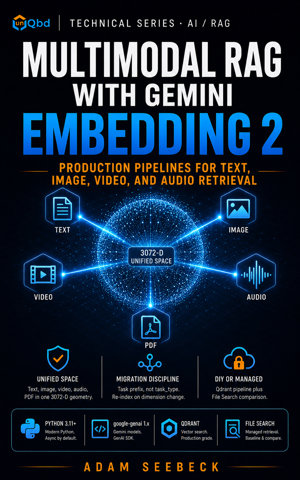
This book is a hands-on guide to building production retrieval systems that process text, images, audio, and video through a single embedding model. It targets AI engineers, ML engineers, applied scientists, and senior software engineers who need to move beyond prototypes into deployed multimodal search and retrieval-augmented generation.
Who this book is for
You should read this book if you design, build, or maintain search and RAG systems that must handle documents, media, and structured content together. Whether you are evaluating Google's managed File Search or need full control over chunking, indexing, hybrid retrieval, and evaluation, this reference implementation gives you a concrete baseline you can adapt to your own infrastructure.
What you will learn and build
You will construct a complete DIY pipeline using Gemini Embedding 2, from ingestion through deployment. The projects include token-aware text chunking, PDF batching, image and interleaved embedding, audio and video segment processing, Qdrant indexing, tenant-aware retrieval APIs, hybrid search with BM25 fusion, reranking, agentic retrieval loops, and grounding assembly. You will also build evaluation harnesses, cost models, observability dashboards, and blue-green re-indexing strategies. Chapter 12 closes with a direct comparison to Vertex AI File Search so you can choose managed or self-hosted paths with clear criteria.
How to use this book (recommended reading path)
Read Part I to establish your environment and select embedding dimensionality before generating any vectors. Part II guides you through modality-specific ingestion pipelines; follow these chapters in sequence because each extends the canonical metadata schema and caching layer introduced in Chapter 4. Part III connects your embedded content to Qdrant and layers retrieval techniques from basic search through agentic loops. Part IV adds evaluation, scaling, and deployment. If you are under time pressure, read Chapters 1, 3, 7, 8, and 12 first to understand the full architecture, then return to the embedding and operations chapters.
High-level prerequisites
You need intermediate Python skills, familiarity with REST and gRPC APIs, and working knowledge of vector databases. Experience with Google Cloud, VS Code debugging, and basic MLOps practices will help you move faster, though the text provides configuration templates for each tool and explains authentication patterns for both Gemini API and Vertex AI.
