About This Book
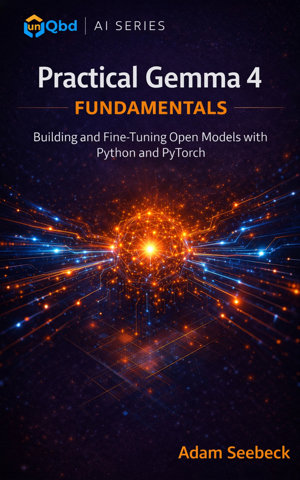
This book teaches you to build, fine-tune, and deploy Google's Gemma 4 open-weight language models using Python and PyTorch. You will develop a complete support ticket triage assistant that classifies requests, drafts responses, and respects privacy and safety constraints, all without relying on closed APIs or external services.
Who this book is for
This book is for intermediate Python developers who understand basic machine learning concepts and want to run open-weight large language models on their own infrastructure. If you are comfortable with Python packaging, virtual environments, and fundamental ML ideas like training and validation splits, this book will guide you through the specific practices of local LLM inference, parameter-efficient fine-tuning, and production deployment. You do not need to be a deep learning researcher, but you should be ready to write and debug PyTorch code.
What you will learn and build
You will construct an end-to-end ticket triage system that processes customer support requests through classification, prioritization, and response generation. Along the way, you will master Gemma 4 model variants and tokenization, implement reliable inference with proper chat templates and generation controls, and design evaluation harnesses that measure real-world performance. You will implement LoRA and QLoRA fine-tuning to adapt models efficiently, prepare datasets with privacy safeguards, apply quantization for deployment, and package your work for Hugging Face Hub. Throughout, you will work within responsible AI constraints including PII handling, escalation boundaries, and safety limits.
How to use this book
The book follows a linear progression from environment setup to production deployment. If you need inference-only skills, work through Part I and Part II to master prompt engineering and pipeline construction. For fine-tuning expertise, continue through Part III, where you will move from supervised fine-tuning to memory-efficient adapter training. Part IV and Part V cover evaluation, optimization, and serving architecture. Each chapter includes runnable Python examples that build toward the final deployed assistant.
High-level prerequisites
You should have intermediate Python proficiency and familiarity with basic ML concepts such as loss functions, gradients, and model evaluation. Prior exposure to PyTorch is helpful but not required; the book introduces necessary tensors and autograd patterns as they appear. You will need a machine with a CUDA-capable GPU for efficient fine-tuning, though CPU execution is possible for smaller model variants and inference tasks. All code examples use open-source tools and the Gemma 4 open-weight checkpoints.
