About This Book
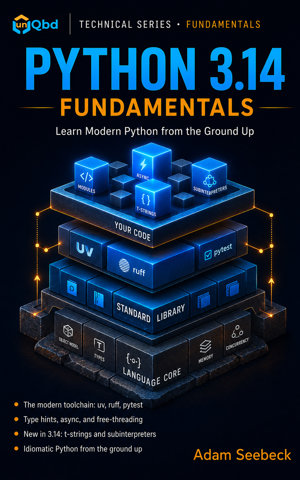
Python 3.14 Fundamentals teaches the language from first principles using the current CPython release. You will learn syntax, the standard library, and the tools that working engineers use daily, including uv, ruff, pytest, and mypy. The material integrates new 3.14 capabilities, including template strings, deferred annotations, free-threaded mode, and subinterpreters, where they naturally fit rather than treating them as afterthoughts. Every example reflects current best practices and the 3.14 toolchain.
Who this book is for
This book suits three groups: developers writing their first Python code; engineers arriving from C#, JavaScript, Java, or Go who need practical, current Python idioms; and existing Python programmers who want to upgrade their toolchain and code style to the 3.14 baseline. No prior Python experience is required, though familiarity with general programming concepts helps. The explanations map Python patterns to constructs you may recognize from other ecosystems, then clarify where Python differs.
What you will learn and build
You will build a Personal Knowledge Tracker, a CLI application that grows from a single script into a tested, type-checked package. Along the way, you will master values, control flow, functions, collections, classes, and async I/O. You will also adopt professional practices: structured logging, custom exceptions, protocol-based design, and automated testing. Each chapter adds a concrete feature to the tracker while introducing the language or tooling concept that supports it. You will start with a minimal CLI, model data with dictionaries, refactor into classes and protocols, add async metadata fetching, and finish with a locked dependency file and CI-ready commands.
How to use this book (recommended reading path)
The four parts follow a linear path from syntax to production workflow. Part I covers installation, the REPL, and basic script structure. Part II explores the core language through functions, collections, and file I/O. Part III introduces modules, packages, classes, and error handling. Part IV addresses async programming, testing, type checking, and deployment configuration. First-time readers should follow the chapters in order. Experienced developers can skim Parts I and II to reach the 3.14-specific material and toolchain chapters, then study Part IV as a self-contained guide to updating their workflow.
High-level prerequisites
You should understand variables, loops, and functions in at least one programming language. The book assumes no previous Python knowledge. You need a computer running Windows, macOS, or Linux with internet access to install Python 3.14 and uv. All other tools are installed automatically through the project configuration. A text editor and terminal access are sufficient; the book avoids complex IDE setup so you can focus on the language itself.
