About This Book
Who this book is for
This book is for software engineers who have moved past prototyping and are now deploying AI agents to production environments. You have already built agents with at least one framework such as the OpenAI Agents SDK, LangGraph, Microsoft Agent Framework, CrewAI, or Google ADK. You understand agent loops, tool calling, and prompt engineering, but you need a systematic way to secure, govern, and observe them at runtime. If you are looking for static scanning or perimeter security alone, this is not the right guide. We focus on what happens when the agent is already running.
What you will learn and build
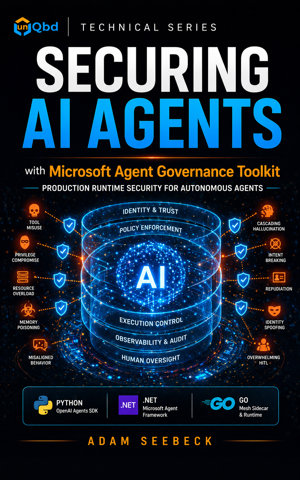
You will build a single reference application that evolves across two frameworks: a Python agent using the OpenAI Agents SDK and a .NET agent using the Microsoft Agent Framework. Using the Microsoft Agent Governance Toolkit, you will implement runtime controls for prompts, tools, and outputs; model trust boundaries and identity; and enforce policies through an evaluation pipeline. You will extend this to multi-agent workflows secured across framework boundaries, including a Rust-based in-process policy evaluator for latency-sensitive paths and a Go-based Agent Mesh sidecar for cross-framework network enforcement. Every control is mapped practically to the OWASP Agentic AI Top 10, with clear guidance on what runtime governance can and cannot solve.
How to use this book (recommended reading path)
Read Part I to understand the runtime threat model, set up your Visual Studio Code lab, and wire up the Python and .NET baselines. Part II teaches policy authoring and introduces execution rings and sandboxing. Part III closes runtime gaps using the OWASP Top 10 as an alignment framework, then scales your design to governed multi-agent systems. Part IV brings everything into production with observability, security testing, deployment topology, and continuous policy operations. If you need integration recipes, the OWASP mapping table, or high-level notes on Agent Marketplace and Agent Lightning, consult the appendices.
High-level prerequisites
You should be comfortable with intermediate software engineering practices and have hands-on experience with at least one agent framework. The labs use Python and .NET, so familiarity with one and willingness to read the other is sufficient. You will need Docker for local sandboxing and a local development environment that can run Visual Studio Code. No prior security expertise is required; we build the concepts from the runtime up.
