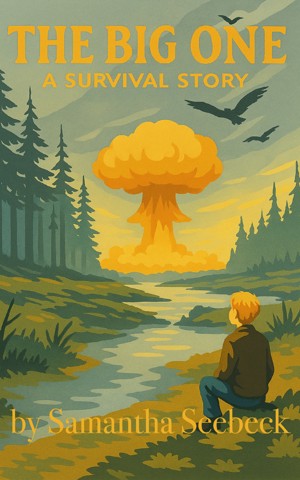
Chapter One: The End
No, to answer your obvious question, there was no school anymore. In fact, I had just picked up my books and started seventh grade in August when, well, ka-blooey.
I was at school when it started. My fourth period science teacher, Ms. Adams, had turned on the news. She was already becoming my favorite teacher. Her class had lots of space and stuff like that. This time though she had said it was really important, happening right now, right here on Earth.
“Earthquake swarms are reported across Montana, Wyoming, and Idaho…” the reporter said.
“I-da-ho!” shrieked some guy in the darkened classroom. I forgot his name, but he probably died pretty early on, you know?
Ms. Adams ignored him and explained. “Swarms are when an area experiences multiple earthquakes in a row, with no predictable pattern.”
Across the country, the newscasters continued. “The National Guard has been deployed to evacuate the area immediately around Yellowstone.”
By fifth period, classmates were getting pulled out of school.
By the time the bus dropped me off at home, my parents were checking the batteries on flashlights, filling water bottles, and charging phones; the kind of things they did before hurricanes.
We live in Florida. That happens a lot.
“They say this is gonna be big. A supervolcano,” my mom explained.
Boy, was it.
The remote cameras were focused on Yellowstone’s volcano, and even the drones were shaking as the earth bucked and rolled and then, almost instantly, a flash of light and then the screens went blank.
Satellite footage took over next, but it brought no reassurance. Smoke rose, choking the air and then lava, over a thousand cubic miles, shot out of the ground. The land literally vaporized to nothing for hundreds of miles, nothing left but smoking ruins. A gaping hole where half the United States used to stretch.
And then there was no television.
The radio came through staticky, telling us ash was settling into the stratosphere around the globe. It would make the whole world darker and cold.
Then the radio, too, was silent.
__________
The electric car rolled silently past us, the members of the Neighborhood Guard hanging out the windows, rifles pointed toward us. Its headlights glowed in the gray evening like the gleaming eyes of hungry wolves.
My heart raced with fear, even though it was a familiar sight. And with longing. I wanted to be strong like them. Unafraid.
“Paul?” my mom said, snapping me out of it.
I had stopped as we were pulling up the last of the scrawny, wilted vegetables. I held a dirty carrot in my hand. In that moment, in that starving moment, it looked like heaven.
“Go on, Paul,” she urged. “You’re a growing boy. You need to eat.” She smiled sadly.
I took a slow bite, the gritty feeling of dirt sticking to my tongue and in my teeth but I didn’t care. Hunger clawed at my stomach and rolled its way up my throat.
Like I was possessed I chewed it as little as I could before I swallowed and moved onto the next bite and the next. Then I dug up another and another, unable to stop. My hands shook and tears pricked my eyes.
My parents’ eyes following food to mouth, food to mouth.
The hunger was replaced by guilt in the pit of my gut that sat there heavy as a stone.
Every bite I took meant less for them.
Bile rose in my throat.
“We could try to fit in one more harvest,” my dad said without any conviction.
“It’s too late for that,” mom whispered in reply.
“We’ll just have to ration,” dad answered. “We’ll have enough canned goods…”
But mom interrupted him. “It’s time we go.”
“Go? Where could possibly be better?” Dad asked.
I wiped my tongue across my sleeve and spat, trying to get the dirt out of my mouth. Instead, I coughed on the dry ash that floated in the air. The coughs shook my wasted body until I almost puked.
“I don’t know if it will be better, but it looks like here it’s getting worse.” Mom sighed and rubbed circles on my back like she did when I was a little kid and sick.
“I’m fine,” I lied.
A sharp crack sounded. We all jumped at the sudden noise. Another gunshot.
“We don’t have enough,” my mother continued with forced calm, still not letting go of me. “Let alone enough for the Guard’s, uh, what are they calling it? ‘Tax’? And then what?”
Dad just looked down at what remained of our pathetic garden.
He used to be so big to me. Now it hurt to look at the way his belly, which used to have a bit of a paunch if I’m honest, sunk in. His dark hair had started turning to silver, and his skin had lost its warm tan color and faded to a sallow paleness.
The Guard made another drive by. They didn’t speak to us. They didn’t have to. Their guns, black and evil looking in the darkening evening, said it all.
“It’s curfew,” she reminded us emotionlessly.
__________
We went into almost complete darkness. Ash had built up on the windows, blocking any lingering sunlight left in the day. Two camping lanterns, which had spent the day out begging for a charge on the solar panels, were our only light.
The outside world’s silence was total.
Inside we settled into our evening routines, pretending that lawlessness, famine, and a winter that was going to be record cold wasn’t lurking outside.
My mom put together a meal of those last few vegetables in a canned broth with some canned beans while my dad worked on mending the family’s socks and underwear.
I knew what I was supposed to be doing; I just didn’t want to.
“Let me help you!” I offered, almost begging.
“You still have one job, kiddo. You have to study,” mom insisted.
My backpack awaited me at the built in desk in the kitchen. Frustration didn’t even begin to cover it.
“The End of the World is no excuse to not turn in your homework,” my mother joked with a wink, tying her blonde hair, the same shade as mine, back in a ponytail and washing her hands to cook.
All I could think was: this is so stupid.
I pushed through my math textbook (determine slope, like I will ever need that) and worked on the social studies questions about the Bill of Rights (yeah, right). It felt like a monumental waste of time, but my parents insisted.
__________
With a sigh, I finished my parent-imposed homework. I was the only kid in the apocalypse still doing it. It was so unfair.
“Here,” I offered, setting down the homework for my mother to look over.
“Hm…” she murmured, both looking over it and tearing up some herbs from the windowsill. “Hey, kiddo?” She smiled and hugged me with one arm, however her voice was solemn. “Thank you. I know you don’t see it now, but this stuff, the Constitution, the Bill of Rights, our history…it matters. More now than ever. We have to remember what we were and what we can be again.”
